One Of America’s Most Famous Movie Sets, Just Outside Vegas

Death Valley National Park is a beautiful oasis just two hours from Las Vegas. It also happens to be one of America’s movie famous movie sets. Of course, if you’re a hardcore Star Wars fan, you probably already knew this. Many spots in the park were used for the filming of two movies in the original Star Wars trilogy.
With its pitch black sky, Death Valley National Park offers some of the best stargazing around. And is actually one of only eight places in the country where you can see the Milky Way with the naked eye, according to drifttravel.com. The park is also a popular spot for campers, hikers and bikers coming both from Nevada and California.
But when May the Fourth rolls around every year, Death Valley sees a lot of extra visitors come in. Anxious to get a spot in line for the self-guided Star Wars driving tour. And if you’ve ever been to Death Valley, you understand why the location was chosen to film the movies. It’s like it’s own little planet. And for a time, it was one: Tatooine.
When Death Valley Was Among The Most Famous Movie Sets In U.S.
The first film in the Star Wars franchise was A Star Wars Episode IV: New Hope. As Star Wars buffs know, it was the fourth chapter in the series but the first movie to be filmed. If you’re doing the self-guided driving tour in Death Valley, one of the six filming spots you’ll see is the Mesquite Flat sand dunes. You might recognize it as the place where R2D2 and C-3PO were wandering around lost in the movie.
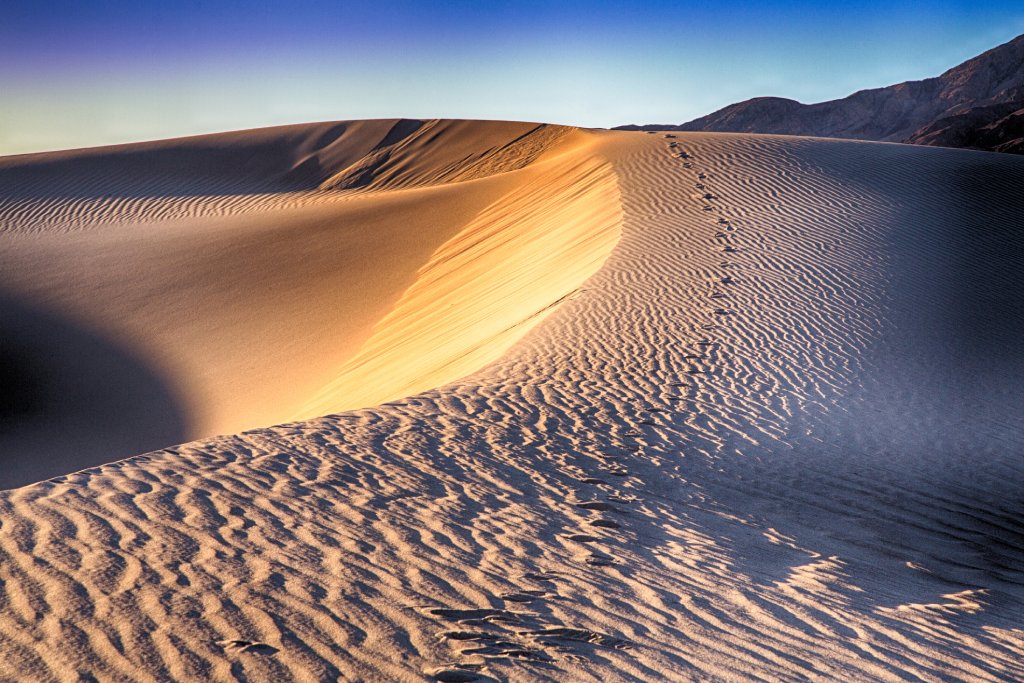
The Mesquite Flat sand dunes of Death Valley National Park, California, USA. This area is among the most famous movie sets in America. It was used for the filming of Star Wars Episode IV in 1976.
Knowing how hot it can get in Death Valley, can you imagine the misery Anthony Daniels went through in that droid costume? The sand dunes serve as location for a few scenes in the film. The scenes with the Sand Crawlers were also partially shot in the dunes.
Related: Nevada Town Is One Of The Year’s Most Instagrammed Places
Another spot on the Death Valley Star Wars tour is Golden Canyon. Also used for Episode IV. This video from starwars.com shows R2-D2 traveling through the same canyon before he gets attacked and captured by the Jawas.
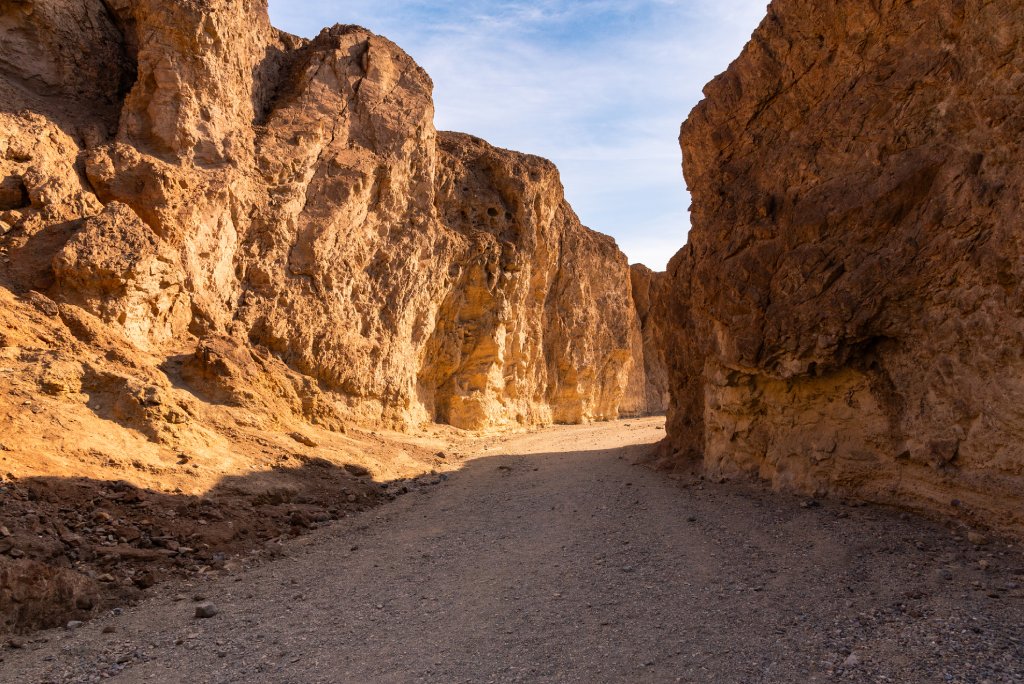
Golden Canyon in Death Valley National Park. Where a scene in Star Wars: A New Hope was filmed.
One of my favorite spots in Death Valley that was used for Episode IV is Dante’s View. This gorgeous spot is easily recognizable from the scene were Luke Skywalker and Obi Wan Kenobi are overlooking Mos Eisley.
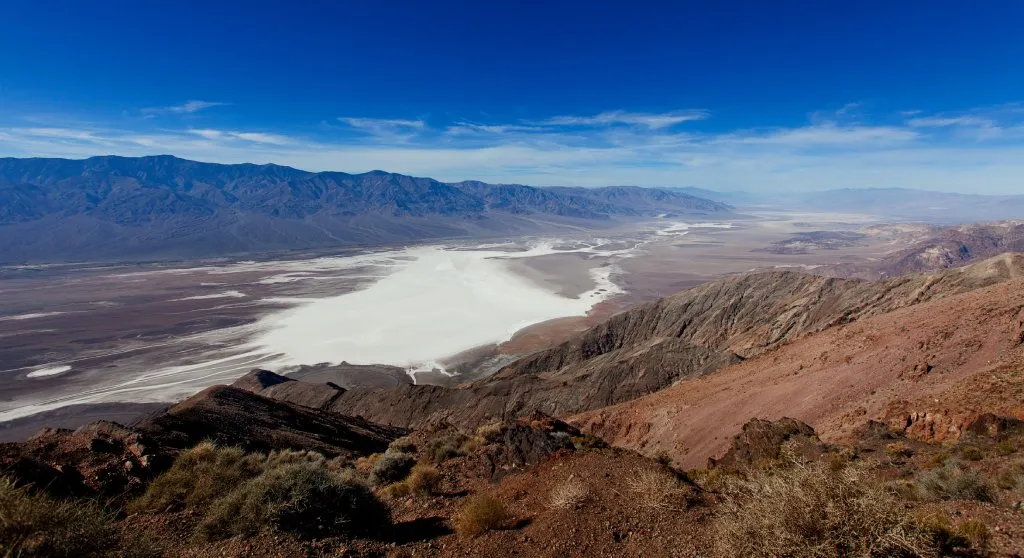
Dante’s View at Death Valley National Park. The location was used for shooting in Star Wars: A New Hope.
There are six locations in total that were used for filming the first Star Wars trilogy. The filming crew also returned in 1982 to shoot part of the “Jabba’s Palace” scene in Star Wars Episode VI: Return Of The Jedi. Though not the cool part where the Sarlacc eats people thrown into the pit. That was filmed in Arizona, according to CNN Travel.
Death Valley National Park is such a cool place that is completely in a world of its own. And every May the Fourth, even more people flock to the area to get a glimpse of what is, to this day, one of the most famous movie sets in film history. If you want to join in on the fun during the next one, these are the six spots you have to see. Make sure you bring your camera!
Want more from this author? Check out her home page.
Death Valley: 25 Reasons To Visit This Stunning National Park
When people think about America’s famous national parks, usually the same list of names will come up. Yellowstone, Yosemite, and Grand Canyon are undoubtedly on the top of that list. Even more locally for us in the Las Vegas area, we’d probably mention Bryce Canyon or Zion before talking about Death Valley. But this national park on the eastern California border is in a world of its own. It’s a place that combines history, record-breaking topography, incredible views, and even a bit of mystery.
When we do talk about this national park, there’s plenty to say. Many enjoy the tales of the disappearing lake that happens after a big storm. Or the rocks that have minds of their own. Death Valley has also made a name for its extremes. Not only the temperatures in the summer, but the depth of the area. According to the National Park Service, Death Valley’s Badwater Basin is the lowest point in North America, at 282 feet below sea level.
What Makes Death Valley So Different
While Death Valley is not the most popular of the national parks, it is one of the largest. According to nationalparks.org, Death Valley covers 3.4 million acres, making it the fifth largest national park in the country. It is over 1 million acres larger than Yellowstone and over 2 million acres larger than Grand Canyon. The park is 140 miles long and lies mostly in California. But a small portion does overlap the state line and reach into the Bullfrog Hills in Nevada.
But the size is not the most impressive thing about Death Valley. Actually, it would be difficult to narrow down what is. Though many people would agree it is the night sky. Once the sun sets, the lack of light pollution makes the sky in Death Valley so dark, that some objects are visible that can’t be seen anywhere else in the world, according to nps.org. Including the International Space Station.
Death Valley is one of only eight places in the country where you can see the Milky Way with the naked eye. Which makes the park a very popular place for campers. Of course, summer months are not an ideal time to visit the park, which, according to nationalparks.org, is the hottest and driest national park in the country. Summer temperatures in the park typically reach a high of 120 in the shade, nps.gov reports. Though they recorded the hottest temperature in 1913, when the heat climbed up to 134 degrees.
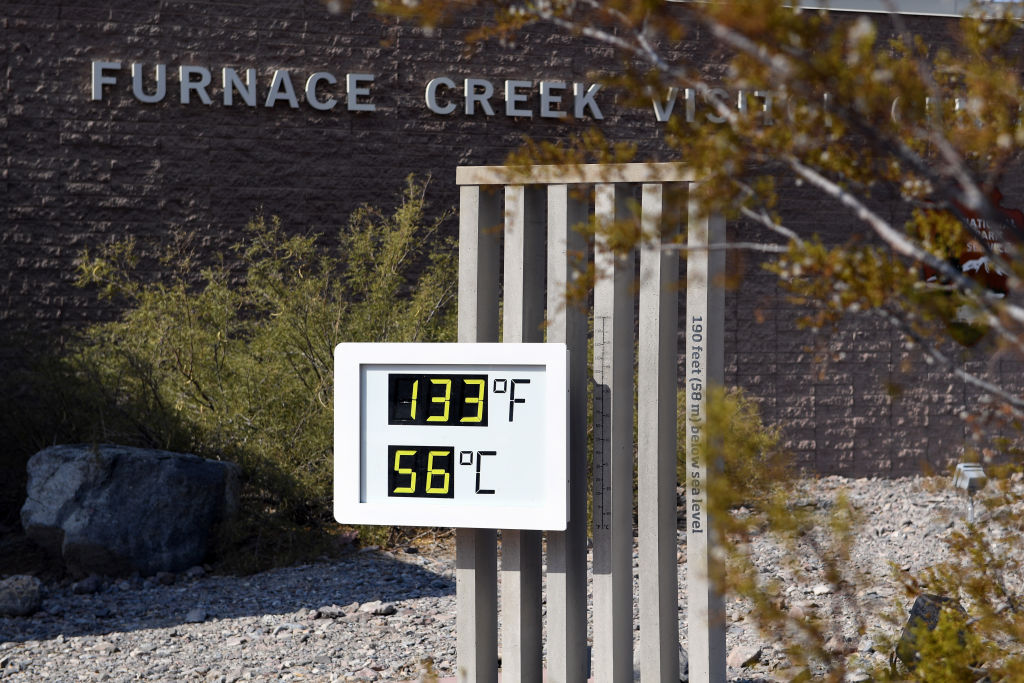
An unofficial thermometer reads 133 degrees Fahrenheit/56 degrees Celsius at Furnace Creek Visitor Center on July 11, 2021 in Death Valley National Park, California. Just one degree lower than the record high of 134 degrees, recorded in 1913. Climate models almost unanimously predict that heat waves will become more intense and frequent as the planet continues to warm. (Photo by David Becker/Getty Images)
May is a very popular month for visitors in the park. Even though temperatures have already gotten to 100 degrees typically by this time, Star Wars fans flock to the area for May the Fourth. Specifically to take the self-driving Star Wars tour of the areas where two of the famous movies in the franchise were filmed.
Historians of all kinds also visit to see glimpses of what was once a thriving mining community. Death Valley’s mining history goes back to about the 1850’s. Minerals of all kinds were found in the California hills, according to nationalparks.org. Including gold, silver, copper, tungsten, lead, zinc, antimony, and borax. The mining communities include Harmony Borax Works, Keane Wonder Mine and the popular town of Rhyolite.
Even without all the mining and movie history, Death Valley has so much to see. In addition to the disappearing lake and mysterious moving rocks, there’s an extinct volcano, ghost towns and much more. Here are just a few of the amazing sites you would see if you visited.
25 Reasons To Visit Death Valley National Park